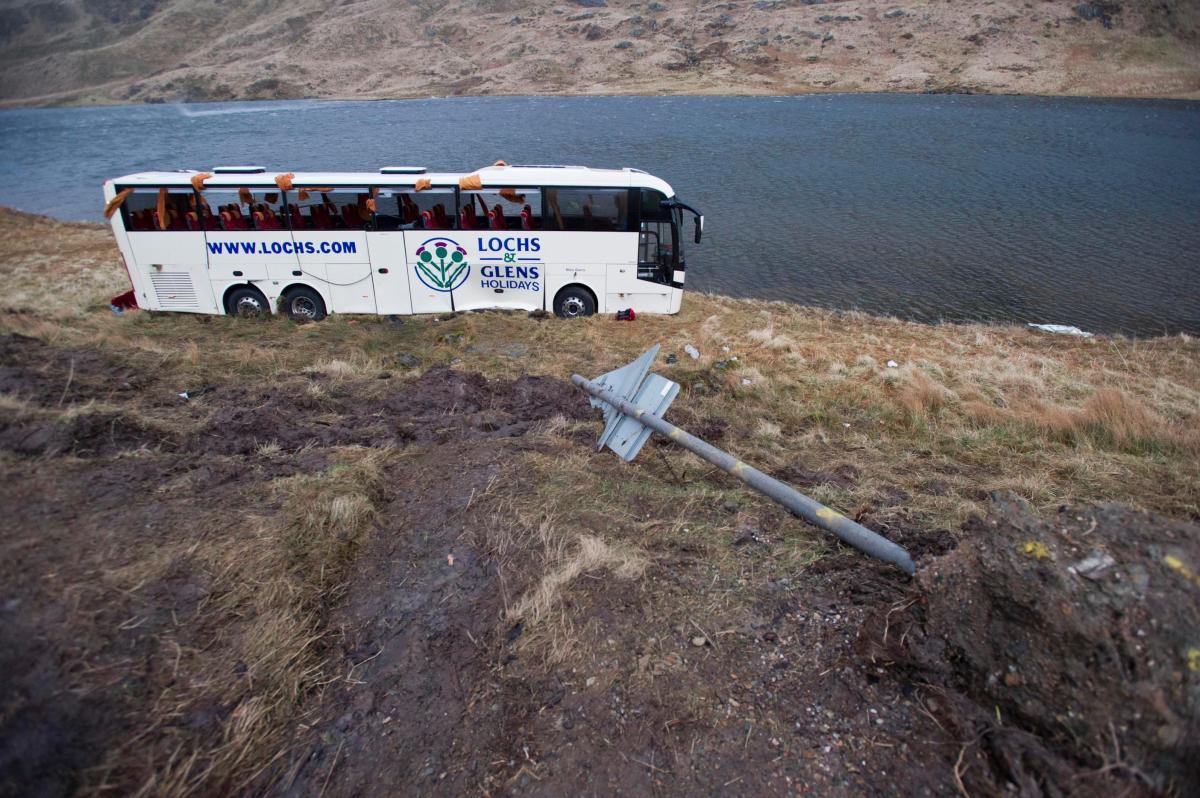
Woodhouse v Lochs and Glens (Transport) Ltd. [2019] CSOH 105
This recent case from the Outer House in Scotland warrants a quick summary for both lawyers and operators/drivers.
It goes without saying that Scottish law is not easily translatable to that of this jurisdiction, but the reasoning of Lord Glennie may be of some persuasion in borderline cases.
Facts.
The pursuer (plaintiff) was a passenger on the bus of the defender (defendant) which came off an A-road in the Scotland highlands, rolling once and coming to rest quite a distance from the road with 51 passengers. The driver claimed that high winds pushed the bus over the verge.
Issues at trial.
The case is largely a non-descript trial of an RTA-related PI; but an argument raised by the plaintiff is noteworthy on account of its scarcity in the law reports.
It had been argued that a reverse burden ought to apply – suspending the normal common law rule of ‘he who asserts must prove’.
Plaintiff’s submissions
Mr Milligan QC suggested that the fact a well-maintained and properly driven bus came off the road gives rise to a prima facie inference of negligence. The suggestion of adverse weather conditions does not avail the defendant of a rebuttal of this – drivers are under a duty to drive accordingly to the weather conditions.
Defendant’s submissions
Mr Primrose QC retorted that the reverse burden and res ipsa loquitur only applied where ‘all the factors contributing to the accident were within the control of the defenders’ and ‘in circumstances where the pursuer did not know and could not know the cause of the accident’.
Decision.
At [29], Lord Glennie cited part of his decision in Morton v West Lothian Council (2006):
“The justification for such a shift is obvious; not only are all the circumstances under the control of the defenders but the defender will have the means of knowing what occurred. The shift is necessary to avoid the denial of justice to those whose rights depend on facts incapable of proof by them… the onus shifts to the defender to prove, at the least, the existence of other facts or circumstances which might have caused the accident without his negligence”
In relation to the facts of the instant case, at [30], Lord Glennie decided that
“everything relevant to the accident involves matters within their knowledge and control… It is theoretically possible for the pursuer to find out what the defenders have done and not done in relevant respects, but in reality the rules of pleading and recovery of documents mean that there are likely to be gaps in what the pursuer can explore with a view to pinpointing where the fault lies.”
As such, he held that Lochs and Glens (Transport) Ltd were indeed on the wrong side of res ipsa. In any event, however, they easily discharged this evidential burden.
I proffer two points to this. First, this again marks a further liberalisation of the rules of res ipsa in comparison with the other two jurisdictions, but as mentioned at the beginning, such arguments may arise in a persuasive manner given Lochs and Glens (Transport) Ltd is now one of the most authoritative cases on the matter in Scots law.
Secondly, it appears that Lord Glennie’s decision in Lochs and Glens but also from Morton are driven by concerns of equality of arms in litigation – or to put it in less guarded terms, it would perhaps be the best explanation for it. If we examine the reasoning at [30], it is difficult to see quite how everything relevant to the accident is within the knowledge of the defender. The obvious retort to this point is the adequacy of litigation pleadings and discovery; however, the ‘gaps’ in such procedures allegedly create a potential injustice to pursuers.
That being said, provided the burden can be discharged by simply offering an explanation for the accident which does not include negligence of the defendant, then perhaps the shift is negligible to the point of becoming illusory.
A word of warning to operators and drivers.
Given the potential for substantial damages, this case was vigorously pursued and defended with an impressive amount of detail and the engagement of experts not usually to be seen in RTA PI actions. The following topics were investigated:
- Condition of the coach
- Weight distribution of the coach
- Stop at the lay by (use of tachograph downloads)
- Speed
- Reaction time
There is no need for me to explain each of the above. But as always, these reported cases send warning shots across the bows of operators – documentation needs to be completed to virtual perfection. For drivers, momentary absent mindedness may be overlooked 95% of the time, but when a gust of wind comes along and you are on the line for causing injury, loss and damage to 51 people, small infringements are magnified.
There is also a word of warning for operators on encouraging or even permitting drivers of high-sided vehicles to continue in adverse weather conditions. My next blog may shed some light on that topic!
 Transport Law NI