
At a recent hearing before the Traffic Commissioner on behalf of an operator who had a bridge strike, a curious technicality arose in relation to a particular model of vehicle. The manufacturer will remain nameless but those of us who have had the great privilege of piloting them will know to whom I refer.
The facts were very simple. This was not a bridge strike where the trailer could never fit under. The height limit for the bridge was 4.2m. The height of the trailer (when sat level) was 4.2m. The driver had changed the in-cab height marker to reflect this. Travelling under the bridge should be seamless, albeit will little margin for error.
Alas it was not to be. Contact was made with the bridge by the bewildered driver.
In short, ‘4.2m based on a 1250mm 5th wheel height’ a declaration that we are all familiar with, had been overlooked. The former figure was taken as absolute. The latter figure was assumed to apply.
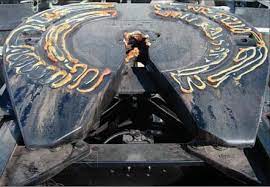
In reality, the vehicle unit’s 5th wheel did not sit at 1250mm. It came from the factory with an axle-down height of 1285mm. This is the first issue. When the mid-lift axle is raised, the 5th wheel height is increased 50mm to 1335mm. The dye was cast. The true dimensions of this vehicle made a collision inexorable.
These two issues will be familiar to those of us who have driven this marque on mainland Europe, particularly in Holland. The golden rule being that, when pulling a fridge, even when empty, the mid lift must stay down at all times lest your Thermoking will be violently stripped of its crown.
All of this is to say that there are two issues which seem to largely elude many operators running mixed fleets:
- That 5th wheels of this particular manufacturer tend to sit higher on the drive axle (above 1250mm).
- Some 5th wheel heights can vary based on its thickness.
- Some vehicles lift the drive axle airbags slightly when the lift axle is raised in order to avoid the lifted wheels dragging on the road (which may lead to ‘flat spots’ on the tyres over time).
This is not something which has been recognised by all operators. Many do, of course, but it is not something which features in most of the height awareness training I have seen. Emphasis is put on the driver assessing the height of the trailer (usually by looking at the height marker on it) and no or little consideration is given to the true height once hooked-in and running height is set. The unit’s contribution to the height is not factored.
Although there is only a maximum discrepancy of around 8cm in all of this, which may not be quite enough to destabilise a bridge on impact, it is more than enough to make contact with a bridge which will lead to a preliminary hearing which will then then lead to a discovery of other unrelated compliance oversights.
The operator in this particular case had, after the incident, measured the 5th wheel height for each one of its vehicles for both axle up and axle down and produced cards with that information, bespoke to the registration, which are kept in the vehicles.
In summary, beware the 1250mm standard. The prevalence of these type of vehicles, with the higher 5th wheel height, are such that 1250mm perhaps cannot said to be a standard any longer, but merely one of two options.

 Transport Law NI